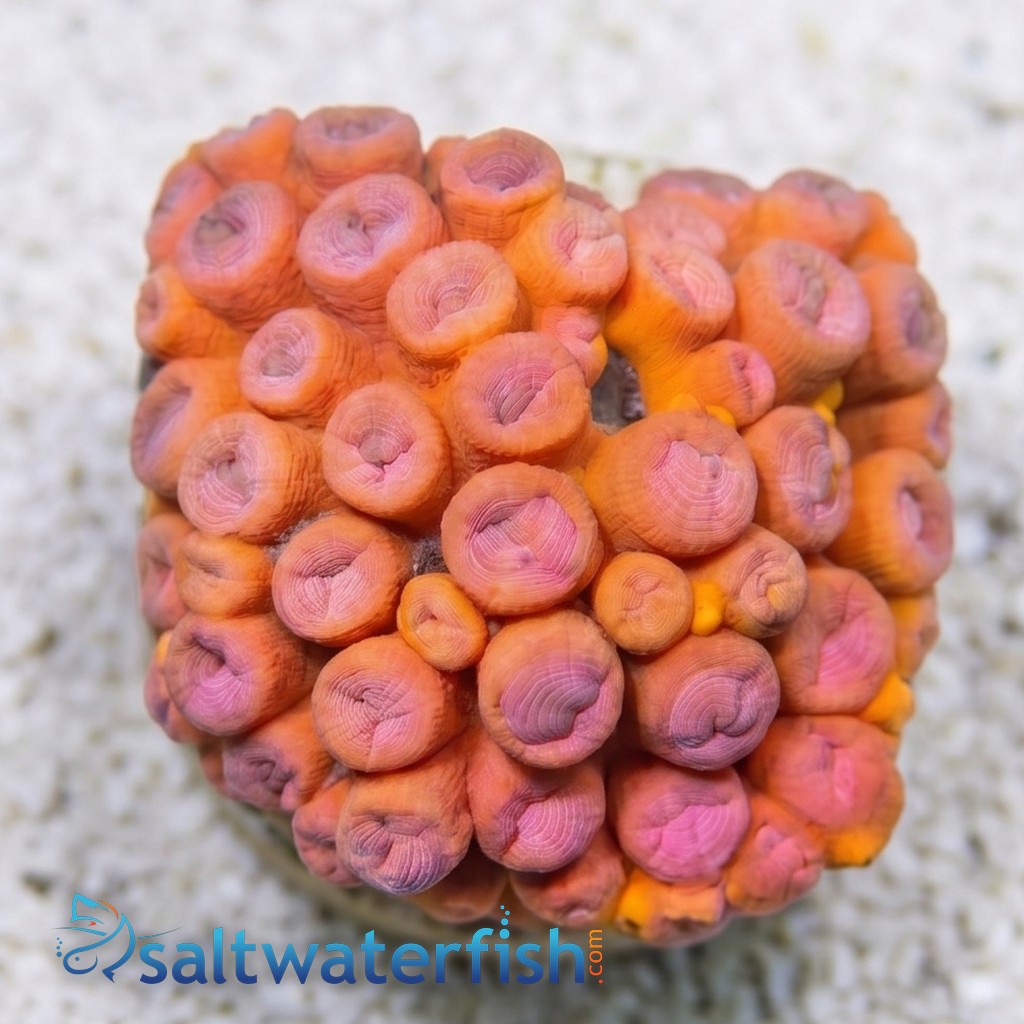
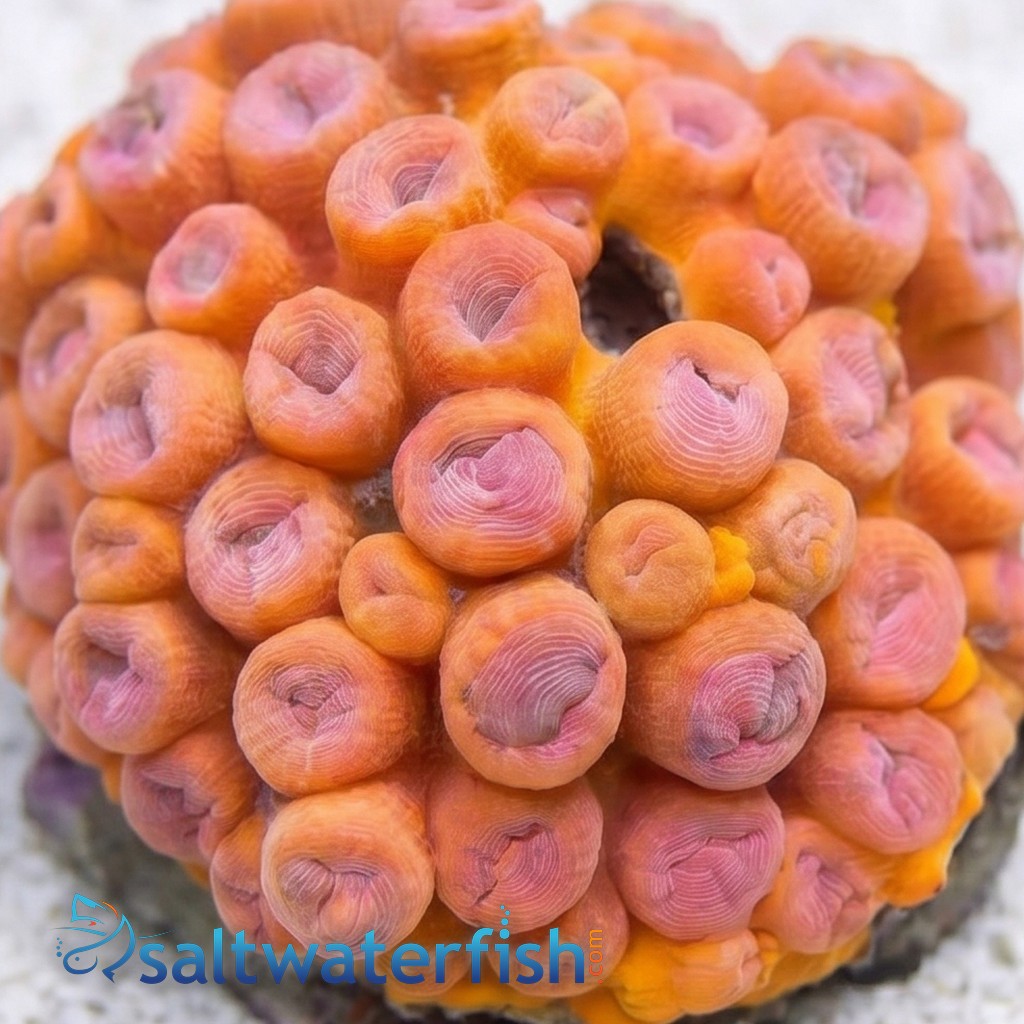
The Sun Coral is a gorgeous coral with stunning coloration that makes a great addition to any reef tank. The Sun Coral needs a targeted feeding and should be taken care of only by experienced aquarists. It should only be bought in your aquarium if you are ready to feed it every other day with a targeted feeding process. Normally during the day, the Sun Coral retracts itself since it is a nocturnal animal, but it can be acclimated to feed during the day and might remain open. The Sun Coral greedily grasps and ingests meaty plankton that comes in contact with its tentacles. The Sun Coral can be fed using a pipette, syringe or turkey baster, and can be trained like this to be fed with the lights on. It is advisable to soak the food in reef supplements and vitamins that help in maintaining a high level of nutrition. The Sun Coral is generally not suitable for most community tanks, where insufficient food or too much light is provided. It is possible to breed the Sun Coral in captivity and needs high-current areas, where it can reproduce in asexually by generating a small yellow polyp in various areas around the tank. The Sun Coral is peaceful towards other marine aquarium inhabitants and is colonial in nature. It thrives well in a temperature range of 72-78 degree Fahrenheit, and with pH of 8.10-8.40. The Sun Coral can be placed on some substrate, such as cave or shielded rocky area at the bottom of the aquarium, and therefore opens up after settling down properly in your reef tank.
Tubastrea, a.k.a. Sun Coral, is a hard coral that does not require any significant light source. These corals are bright orange in color and should be spot-fed. They can be placed into rockwork and prefer to be beneath a ledge where they will be shaded from high light. These corals can stay closed for long periods of time and may only open when you are not present, but they are still beautiful and brightly colored when closed.Corals are part of a biological group known as Cnidaria. Most Cnidaria have a mouth, or mouths, that opens into one big body cavity. Due to the lack of a true digestive system, this cavity acts in its place and after the food is broken down the nutrients are then sent through the rest of the body as food. There is also no excretory system; therefore the waste is sent back through the mouth or secreted into the surrounding water.Tentacles of varying size will usually surround the mouth of Cnidaria. Most Cnidaria have tentacles with stinging cells that can shoot tiny poison darts into their prey or can even be used as a defense mechanism. Some corals lack tentacles and instead cover themselves with a thin layer of mucus and use that to collect bacteria and plankton as food. Some corals even use both of these methods. Cnidaria can either be an individual animal or members of a complex colony. These "Colony Corals" share the food and nutrients taken in by each individual.Corals have tiny living organisms that actually live in their tissue. These are called zooxanthellae and they are the reason why such strong lighting is needed in the saltwater aquarium. These algae-like creatures provide the coral with oxygen and other nutrients that are produced during photosynthesis. During this process, the zooxanthellae take up carbon dioxide and provide nutrients to the coral.Corals can use two different types of defense mechanisms. One of which is a sweeper tentacle wherein the coral reaches its tentacles out to try to damage another coral with nematocysts. The other is when the coral releases a minute amount of toxin into the water to poison another coral within certain proximity. Most "Hard Corals" should not be placed within reach of another coral.